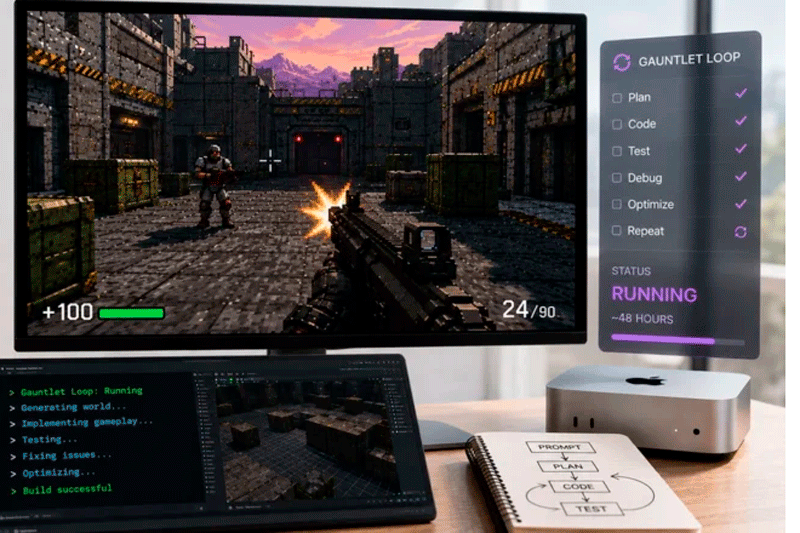
Grok 4.6 has built a playable 3D shooter prototype during a 48-hour autonomous development session, highlighting how AI coding systems are moving beyond isolated code generation toward longer workflows involving implementation, testing, and repeated iteration.
The experiment relied on Gauntlet Loops, an approach popularized by developer Matt Shumer. Instead of asking a model to produce a finished project in a single response, the system is given a task and evaluation criteria before repeatedly building, checking, and improving its output. This allows an AI agent to continue working for hours without a developer manually directing every individual step.
During the two-day run, Grok 4.6 produced a first-person shooter featuring a 3D environment and several fundamental FPS systems. The prototype included player movement, weapons, shooting, and reloading.
The notable part of the demonstration is less the complexity of those mechanics than the length of the autonomous workflow. Rather than stopping after generating an initial implementation, the model continued working on the project and iterating on its own output.
Gauntlet Loops have already been tested with other frontier models. Shumer previously documented a Call of Duty-style game project that began with a single prompt and continued for hours, with the agent spawning subagents and producing roughly 55,000 lines of code. Its textures, meshes, animations, and audio were also generated programmatically during the process.
Grok 4.6 arrived in August 2026 as the latest iteration of the Grok model family. Early independent evaluations placed it among the leading models on broader intelligence and agentic workloads, while long-running AI agents have become an increasingly important part of the platform’s development direction.
For game development, that distinction matters. AI tools have been capable of generating scripts, assets, and simple playable projects for some time. A system that can remain productive across a multi-hour development loop could instead take responsibility for larger parts of prototyping, repeatedly modifying code and addressing issues without requiring a new prompt for every change.
The resulting project should not be confused with a production-ready game. Building basic FPS mechanics is only one stage of development, while optimization, level design, balancing, hardware testing, content production, and quality assurance remain substantially more demanding.
The Grok 4.6 experiment therefore serves primarily as a test of autonomous software development. If AI agents can eventually maintain reliable development loops across much larger projects and longer periods, their role in game development could expand from generating individual pieces of code to handling meaningful portions of the prototyping pipeline.