On August 16, 2016, Paragon entered open beta on PC and PlayStation 4. Ten years later, Epic Games’ ambitious third-person MOBA remains a fascinating case in live-service history: the original game lasted less than two years, yet its characters, technology, and community survived long enough to form the foundation of another MOBA.
Paragon was designed to occupy an unusual space between established genres. It borrowed the familiar structure of League of Legends and Dota 2 – lanes, towers, minions, team fights, and progression within individual matches – but replaced the traditional overhead perspective with a third-person camera.
The free open beta officially began on August 16, 2016 after several months of paid Early Access, bringing the game to both PC and PlayStation 4. Epic was also operating on an aggressive content schedule, with new heroes planned at regular intervals.
A MOBA built like an Unreal Engine showcase
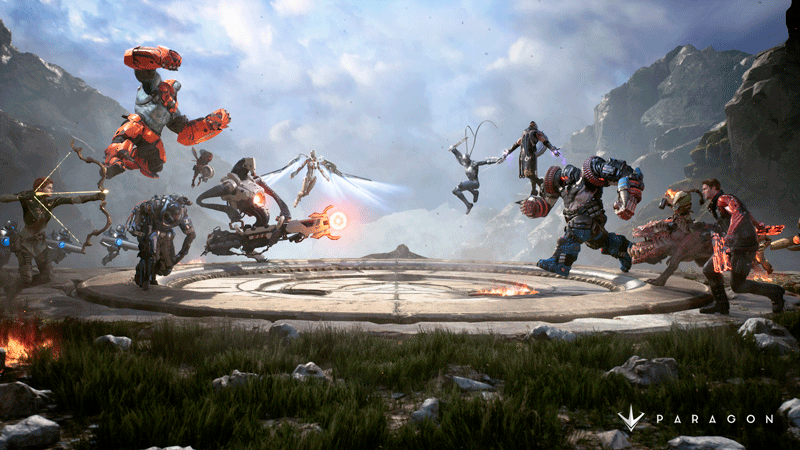
Paragon immediately stood apart on presentation. Epic used Unreal Engine 4 to deliver detailed character models, elaborate ability effects, complex lighting, and large three-dimensional environments at a fidelity rarely associated with MOBAs at the time.
The camera changed the gameplay as well. Many attacks had to be manually aimed, vertical positioning mattered in combat, and ranged characters could feel closer to shooter archetypes than traditional point-and-click MOBA heroes.
That identity was Paragon’s greatest strength, but it also made the game unusually difficult to design. Epic was balancing conventional MOBA systems while simultaneously experimenting with mechanics that had few established equivalents elsewhere in the genre.
Over its short lifespan, the game went through major revisions to its pacing, progression, card systems, and map design. Legacy was eventually replaced by the smaller Monolith battlefield. Epic would later describe Paragon’s development as a period defined by repeated large-scale overhauls and constant design changes.
For a competitive live-service game, that instability mattered. MOBAs depend on players spending hundreds of hours learning matchups, economies, builds, and map timings. Repeatedly rewriting those fundamentals made it difficult for Paragon to establish a lasting identity.
Fortnite accelerated the problem – it did not create it
Paragon’s closure is often reduced to one explanation: Epic sacrificed it so developers could work on Fortnite.
There is truth behind that account, but it leaves out an important part of the story.
Fortnite Battle Royale exploded in popularity after its 2017 launch, creating enormous internal demand for developers. Epic acknowledged that Fortnite’s growth had pulled resources from the Paragon team.
Paragon, however, was already struggling with player retention and sustainability. When Epic announced its shutdown in January 2018, the company said it could not see a clear path that would allow the game to grow into a sustainable product. Servers were scheduled to close on April 26, with Epic offering refunds for purchases made by players.
Fortnite was therefore less the single cause than the final piece of a difficult business equation.
Epic had one competitive game still searching for a stable formula and another rapidly becoming one of the biggest entertainment products in the world. Resources naturally followed the latter.
Epic did something unusual after pulling the plug
For most live-service games, a shutdown means years of character art, animation, environments, and effects disappear into an archive.
Paragon took a different path. In March 2018, Epic began releasing the game’s production assets free for Unreal Engine developers. The first major collection alone represented more than $12 million in development work, including 20 AAA-quality characters with skins, animations, visual effects, and dialogue, alongside more than 1,500 environment components.
That decision gave Paragon an unusual afterlife. Its characters and environments started appearing in prototypes, independent productions, and development experiments. More importantly, several teams attempted to build their own successors around the concepts and assets Epic had abandoned. The most successful of those projects became Predecessor.
Predecessor turned a dead game’s community into a studio
Omeda Studios emerged directly from the Paragon community. Founder Robbie Singh had previously produced Paragon content, while the eventual development team used Epic’s released assets to accelerate early prototyping.
Singh later said those assets allowed Omeda to reach its first multiplayer playtest in less than six months. The studio subsequently received an Epic MegaGrant and had raised more than $22 million in outside funding by 2022. Former Paragon creative director Steve Superville also joined the project as an adviser.
Predecessor was never intended to be a literal restoration of Paragon. Omeda retained recognizable heroes and the third-person MOBA concept but rebuilt important systems, including itemization and progression, around its own design goals.
On August 20, 2024, Predecessor reached version 1.0, more than six years after Epic shut down Paragon’s servers.
That created an unusual full-circle moment. Epic shut down its own MOBA, released its production assets for other developers, and later supported through the MegaGrants program a studio building a new game from that legacy.
Why Paragon still matters a decade later
Paragon ultimately failed at its original objective. It never became a major rival to League of Legends or Dota 2, and its entire public life effectively remained within Early Access and open beta. But describing it only as a failed MOBA misses what happened afterward.
Epic gained experience running a large cross-platform service at a time when unified PC-console ecosystems were still far less common. Unreal Engine developers received a library of production-quality assets that would have been prohibitively expensive for most small teams to create independently. And a community that lost its game eventually helped produce another one.
Ten years after the open beta began, Paragon’s most unusual achievement may be that its shutdown was not actually the end of its story.
Epic could not build a sustainable future for the original game. By opening its work to other developers, however, it gave somebody else the opportunity to do so.