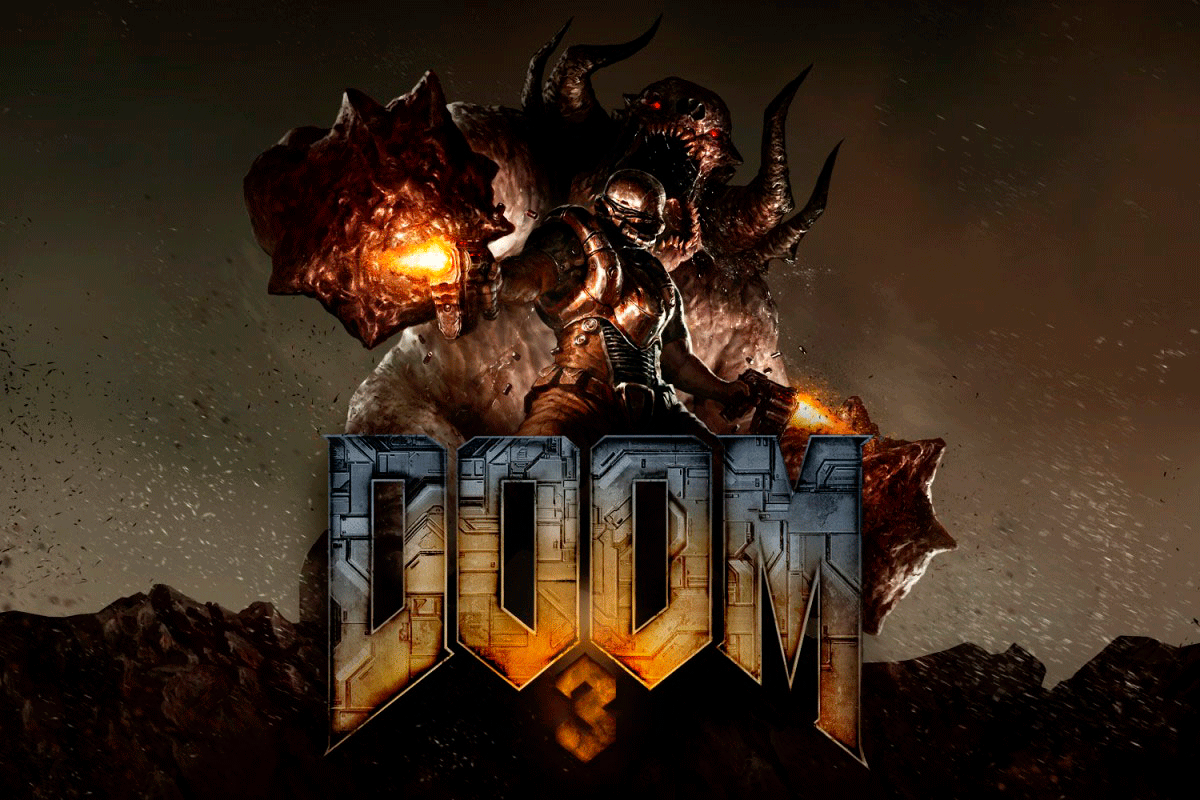
DOOM 3 is 22 years old. Released on August 3, 2004, id Software’s shooter represented one of the most dramatic departures in the history of the franchise while doubling as a showcase for a new generation of PC graphics technology.
Rather than simply making the original DOOM formula faster and larger, id Software took the series in another direction. Dark corridors, restricted visibility, environmental storytelling and a heavier reliance on sound and lighting pushed the game significantly closer to horror.
Behind that shift was one of DOOM 3’s most important contributions: id Tech 4.
A game that made PC upgrades matter
By the time DOOM 3 arrived, id Software already had a reputation for introducing technology that influenced the wider PC gaming industry.
Wolfenstein 3D helped popularise first-person shooters, the original DOOM became one of the genre’s defining releases, and Quake pushed fully 3D environments into the mainstream.
DOOM 3 continued that pattern.
The game was demanding by 2004 standards and quickly became a common benchmark for graphics cards and processors. Hardware publications regularly used it to compare new components, while performance in id Software’s latest shooter became a useful indication of what contemporary NVIDIA and ATI GPUs could deliver.
Crysis would develop a similar reputation three years later. For PC players in the middle of the 2000s, however, DOOM 3 was already demonstrating just how quickly high-end hardware could become stressed by the next generation of graphics.
And polygon counts were only part of the story.
id Tech 4 turned lighting into gameplay
DOOM 3 became the first game powered by what would later be known as id Tech 4.
One of the engine’s defining features was its unified approach to lighting and shadows. Real-time lights could interact with objects and characters while dynamic shadow volumes helped create scenes that looked markedly different from many games built around more heavily precomputed lighting solutions.
That technology was particularly important because of the type of game id Software wanted to make.
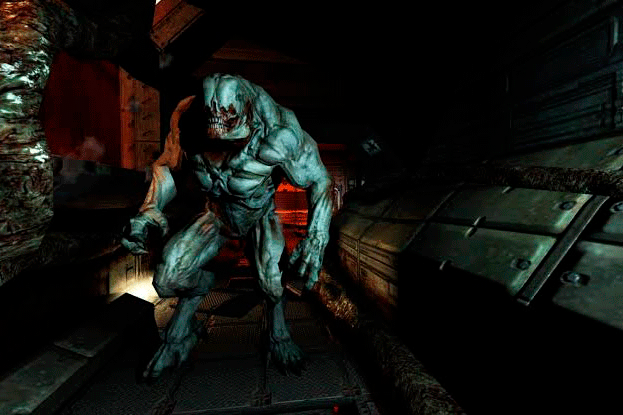
Lighting inside the UAC’s Mars facility was not simply decorative. Emergency lamps, machinery and other light sources defined what players could see, while moving shadows could suggest the presence of an enemy before it entered view.
Darkness became a design tool. The engine also made extensive use of normal and specular mapping. The techniques allowed artists to produce the impression of far more detailed surfaces without constructing every small feature from geometry.
Metal walls, machinery, characters and creatures consequently looked substantially more complex than their raw polygon counts suggested.
John Carmack was the key technical figure behind the engine, continuing a run of graphics work that had already helped define previous generations of id Software games.
The engine went far beyond DOOM
id Tech 4 did not remain exclusive to DOOM 3.
Raven Software used the technology for Quake 4 in 2005, while Human Head Studios built Prey on it the following year.
Splash Damage also created Enemy Territory: Quake Wars using a modified version of the technology, adapting the engine for substantially larger outdoor environments. Later titles including Wolfenstein and Brink also used versions of id Tech 4.
DOOM 3 therefore served as the first major demonstration of an engine that continued powering commercial games for years.
The technology gained another life in 2011 when id Software released the id Tech 4 source code under an open-source licence, allowing programmers and community developers to examine, modify and port the engine.
Why DOOM suddenly became a horror game
The technological shift was accompanied by an equally significant change in game design.
The original DOOM and DOOM II were built around speed. Players moved rapidly through levels, managed groups of enemies and constantly repositioned during combat.
DOOM 3 deliberately slowed that rhythm.
Its version of the Union Aerospace Corporation’s Mars facility was dominated by narrow spaces and limited illumination. Encounters relied more heavily on anticipation, audio cues and enemies emerging from areas outside the player’s immediate field of vision.
The result was the most horror-focused mainline DOOM game the series had produced.
DOOM 3 was also effectively a reimagining of the original game’s premise rather than a conventional continuation of DOOM II.
id Software took familiar concepts – Mars, the UAC, experimental technology and a demonic invasion – and rebuilt them as a darker, more cinematic interpretation of the DOOM universe.

The flashlight became part of gaming history
Few design choices illustrate that approach better than DOOM 3’s flashlight.
In the original PC release, players could not hold the flashlight and a conventional weapon at the same time. Seeing clearly in a dark room therefore meant temporarily giving up immediate access to a gun.
It became one of the most discussed mechanics in the game.
Some players considered it an artificial limitation. Others argued that the decision strengthened the horror experience by forcing players to choose between information and combat readiness.
The discussion became significant enough that early community modifications were created specifically to solve the issue by allowing players to illuminate rooms while carrying weapons.
Years later, id Software effectively reversed the original decision.
DOOM 3: BFG Edition introduced a revised flashlight system that allowed players to use illumination without completely putting away their weapon.
Strong reviews, divided players
DOOM 3 was well received by critics after launch. GameSpot awarded it 8.5/10, while the PC version holds a Metacritic score of 87.
Its technical achievement was one of the least controversial aspects of the release.
The larger debate centred on its design.
Some longtime players had expected an updated version of the fast, combat-heavy structure associated with classic DOOM and disliked the slower exploration, tight environments and heavier horror emphasis.
Others considered those differences the game’s greatest strength.
That divide ultimately gave DOOM 3 an unusual place within the franchise. It remains one of its most recognisable entries while also being one of the least representative of the formula that would later define modern DOOM.
Resurrection of Evil and DOOM 3’s second life
The story continued after the initial 2004 launch.
Resurrection of Evil arrived in 2005, expanding the campaign with new content and continuing the narrative after the events of the base game.
A much larger re-release followed in 2012 with DOOM 3: BFG Edition.
The package updated the game for newer hardware, incorporated Resurrection of Evil and added The Lost Mission campaign alongside versions of the original DOOM titles.
It also modified several elements of the original experience, with the revised flashlight among the most immediately noticeable.
DOOM 3 would later continue appearing on newer platforms, ensuring that a game originally associated with high-end 2004 PCs remained accessible well beyond its initial hardware generation.

Modern DOOM chose another direction
The significance of DOOM 3 becomes even clearer when viewed alongside the games that followed.
When id Software rebooted the series with DOOM in 2016, it deliberately built a very different experience.
DOOM and later DOOM Eternal emphasised constant movement, aggression and larger combat spaces. Their philosophy was far closer to the pace of the original games than the more cautious structure of DOOM 3.
DOOM: The Dark Ages changed the combat formula again in 2025, but still kept active confrontation at its core rather than returning to DOOM 3’s horror-led structure.
That leaves the 2004 game as something of an evolutionary branch of its own: an experiment in how dramatically id Software could reinterpret a franchise it had helped create.
DOOM 3’s legacy goes beyond graphics
No one would mistake DOOM 3 for a cutting-edge release in 2026 purely from its polygon count or texture resolution.
Its more lasting contribution is the philosophy behind those graphics.
id Software did not simply use new rendering technology to create prettier screenshots.
Lighting controlled visibility. Shadows generated tension. Darkness influenced player behaviour. Detailed interactive displays made the Mars facility feel more like a functioning environment.
Technology and game design were working toward the same goal.
That is why, 22 years after DOOM 3 launched, its importance is not limited to memories of expensive graphics cards struggling to run it.
The game demonstrated how a rendering engine could shape the experience itself rather than simply determine how attractive it looked.
Later DOOM titles would ultimately choose a very different path, but id Software’s 2004 experiment remains one of the most distinctive technological and creative turns in the history of the franchise.