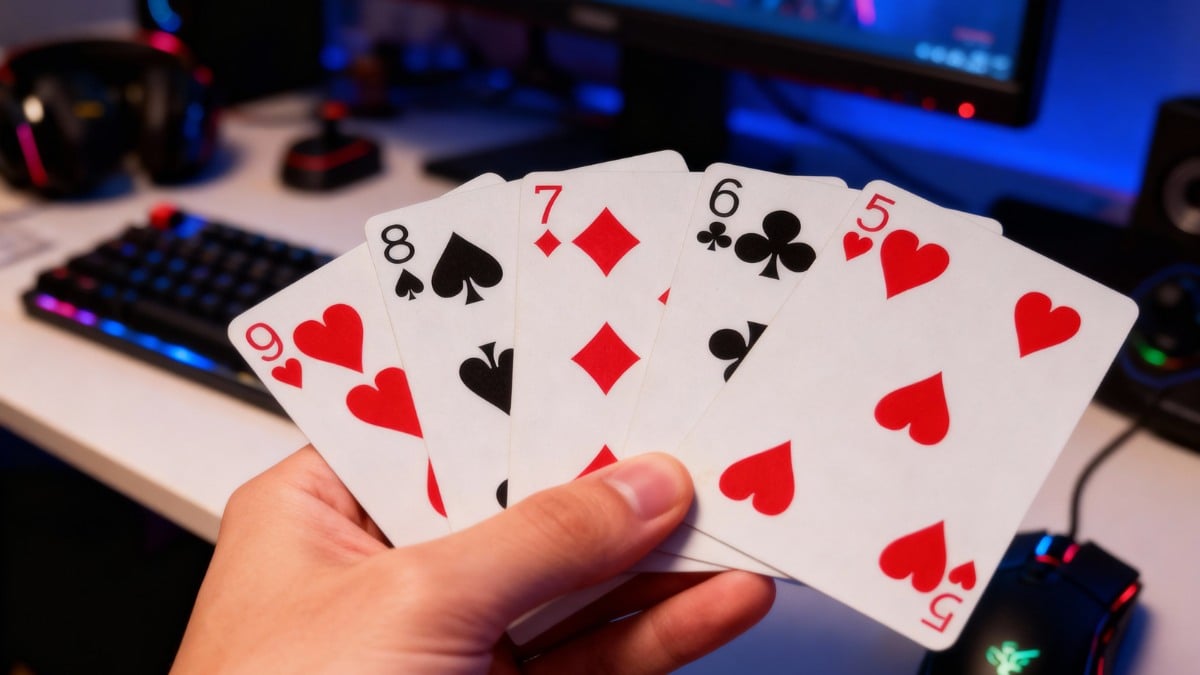
Five card draw is the simplest form of poker, eliminating community cards and complex board dynamics to emphasize hand assessment and strategic bluffing. This traditional game has been a staple in home games and casinos for many years before Texas Hold’em took over in popularity. Grasping its mechanics is crucial for understanding all poker variations.
The charm of this game lies in its straightforwardness. Players receive five individual cards, evaluate their strength, discard the ones they don’t want, and draw new cards as needed. Despite this basic structure, there’s considerable strategic depth involving mathematical probabilities, reading opponents, and deceptive tactics. This guide explores the rules of five card draw, hand rankings, betting structures, and key strategic concepts.
Game Setup and Structure of 5 Card Draw
Five card draw can accommodate between two to eight players, but the best gameplay typically occurs with four to seven participants. The game is played with a standard 52-card deck, poker chips for wagering, and a dealer who rotates clockwise after each hand.
Each hand starts with two forced bets known as blinds. The player immediately to the left of the dealer posts the small blind, usually half the minimum bet, while the next player posts the big blind, equating to the full minimum bet. These mandatory bets create an initial pot and ensure there’s action in every hand.
After the blinds are posted, the dealer hands out five cards face down to each player in a clockwise manner. Players assess their hands without revealing any cards to others. In contrast to games featuring community cards, five card draw relies solely on the players’ private cards without any shared board.
Five card draw tables are regularly available at leading poker sites, attracting both nostalgic old-timers and those discovering traditional poker formats.
Rules of Five Card Draw: Betting Rounds and Progression
The game unfolds through two distinct betting rounds separated by the drawing phase. To comprehend the rules of five card draw, players must understand both betting rounds and how each impacts the strategy for developing a hand.
First Betting Round (Pre-Draw)
The action begins with the player sitting to the left of the big blind, who can choose to fold, call the big blind, or raise. Betting proceeds in a clockwise direction, offering each player the same options depending on the prior actions.
This opening round sets the pot size and provides early insights into opponents’ hand strength through their betting behaviors. Players who are conservative tend to fold weaker hands right away, while more aggressive players might raise with strong hands or even bluff to inflate the pot or apply pressure on their opponents.
Drawing Phase
Once the first betting round is over, players remaining in the game proceed to the draw. Starting with the player to the dealer’s left, participants can discard between zero to five cards and draw an equal number of new cards from the deck. Players typically declare how many cards they are discarding, which can give opponents clues about their potential hand strength.
Choosing not to draw any cards usually indicates a very strong hand or an advanced bluff. Drawing one card often signifies pursuing a straight or flush, while two cards suggest aiming for three of a kind, and three cards may indicate a pair. Discarding four or five cards generally indicates weak holdings.
Second Betting Round (Post-Draw)
After all players have completed their draws, the final betting round commences. The first remaining player in an early position starts the betting, with options to check (remain active without betting) or bet. Subsequent players may check if there have been no prior bets, or they can call, raise, or fold based on existing bets.
This last round decides the final pot size and often sees aggressive betting from players who believe they have improved their hands or sensed weakness in their opponents. The action continues until all active players either call the current bet or fold.
5 Card Draw Hand Rankings: Poker Hand Hierarchy
The hand rankings in five card draw adhere to the traditional poker hierarchy, where higher hands triumph over lower counterparts. Familiarity with hand rankings is critical for assessing whether to stay in a hand and deciding on the appropriate bet amounts.
| Hand | Example | Approximate Odds | Description |
| Royal Flush | A♠ K♠ Q♠ J♠ 10♠ | 1 in 650,000 | Ace through Ten of the same suit |
| Straight Flush | 9♥ 8♥ 7♥ 6♥ 5♥ | 1 in 72,000 | Five consecutive cards of the same suit |
| Four of a Kind | Q♦ Q♣ Q♥ Q♠ 7♣ | 1 in 4,000 | Four cards of matching rank |
| Full House | J♠ J♦ J♥ 5♣ 5♠ | 1 in 700 | Three cards of one rank, two cards of another |
| Flush | K♠ 9♠ 7♠ 4♠ 2♠ | 1 in 500 | Five cards of the same suit that are not consecutive |
| Straight | 10♥ 9♦ 8♣ 7♠ 6♥ | 1 in 250 | Five consecutive cards of mixed suits |
| Three of a Kind | 7♦ 7♣ 7♥ K♠ 4♦ | 1 in 47 | Three cards of the same rank |
| Two Pair | A♠ A♦ 6♣ 6♥ 9♠ | 1 in 21 | Two cards of one rank plus two cards of another rank |
| One Pair | K♥ K♣ 10♦ 7♠ 3♣ | 1 in 2.4 | Two cards of the same rank |
| High Card | A♦ J♣ 9♥ 6♠ 3♦ | 1 in 2 | Five unrelated cards |
The table above ranks five card hands from the strongest to the weakest. Royal flushes and straight flushes virtually always win at showdowns, while high card hands seldom survive without improving. Recognizing these odds helps players decide whether to keep betting or fold less favorable hands.
Betting Limits and Structure Variations
Five card draw features three main betting structures that impact strategy and variance levels.
Limit: All bets are fixed at set amounts. Smaller bets apply during the first betting round, while larger bets, usually double the small bet, come into play after the draw. This approach lowers variance and emphasizes skill over financial pressure.
Pot Limit: Players may wager up to the current amount in the pot. This structure permits larger bets than in a fixed limit while preventing the extreme swings associated with no-limit play.
No Limit: Participants may bet any sum up to their entire stack at any moment. This format allows for maximum variance and highly values psychological insights and aggression.
Casual games commonly use a limit structure due to its accessibility and lower variance.
Key Strategies for 5 Card Draw
Successfully playing five card draw requires a balance between understanding mathematical probabilities and observing opponents while employing strategic deception.
Choosing Starting Hands
Focus on playing primarily strong starting hands: pairs of Jacks or better, high cards that could lead to straights or flushes, or three-card combinations that can become straights or flushes. Immediately fold weak pairs and unrelated low cards. Keeping tight starting hand criteria helps to minimize minor losses across many hands.
Strategy for Drawing
Draw the fewest cards necessary to enhance your hand. If holding three of a kind, draw only two cards instead of retaining a side card kicker. With two pairs, only draw one card to pursue a full house. If you have one pair, draw three cards unless the pair is Queens or higher; in that case, keep a high kicker instead.
Awareness of Position
Players in later positions gain strategic advantages, observing how opponents act before making their own choices. Play more conservatively from early positions and expand your hand range when acting from late positions, especially after several players have folded.
Observing Opponents
Monitor opponents’ drawing habits to gauge potential hand ranges. Players who consistently discard three cards are likely holding pairs, while those who often stand pat or draw one card are doing so to complete straights, flushes, or full houses.
Common Errors and Misunderstandings
New players of five card draw often make several mistakes that can be exploited by attentive opponents.
Overvaluing Low Pairs:
Low pairs (sixes to nines) seldom win showdowns and usually do not improve after the draw. Folding these hands early helps to minimize small losses.
Too Much Bluffing:
The limited betting rounds and gathered information make five card draw less suited for frequent bluffing than variants with community cards. Bluffing works best against cautious opponents in late positions when the pot odds are favorable.
Playing Passively with Strong Hands:
Players with three of a kind or better should aggressively bet or raise before the draw to maximize their potential winnings as these hands typically succeed in most showdowns.
Attempting Inside Straights:
Four-card inside straight draws (for example, 9-8-6-5) rarely complete, at only about 8.5% success, making them poor draws unless the pot odds warrant the call. Outside straight draws (like 9-8-7-6), however, complete approximately 17% of the time and can be justified depending on the odds.
The Conclusion
The straightforward mechanics and focus on hand evaluation in five card draw make it an ideal introduction for new poker players, while still offering enough complexity to challenge more experienced participants. The game emphasizes essential poker concepts such as hand strength assessment, positional value, and opponent analysis, all without the intricacies of community cards and multiple betting rounds.
While modern poker has shifted toward community card games, the classic structure of five card draw maintains the fundamental aspects of poker. Players who master these foundational rules acquire skills applicable across all poker styles while enjoying a game that has captivated players for over a century.
Achieving proficiency in five card draw demands patience, mathematical prowess, and careful observation of opponents. These attributes are also crucial for success in all poker variants, confirming the lasting significance of five card draw as both an enjoyable game and a foundational skill-building exercise for aspiring poker experts.