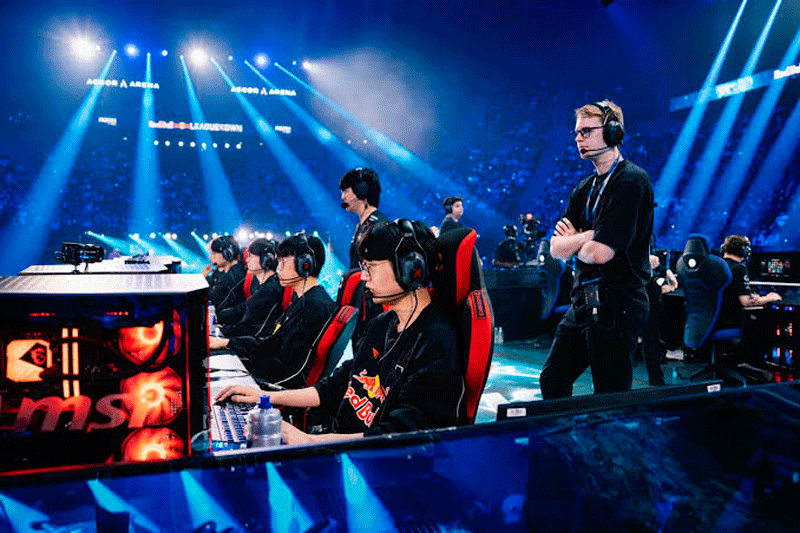
Few organizations have shaped modern esports as profoundly as T1. From its roots in South Korea’s early StarCraft scene to becoming the most successful organization in League of Legends World Championship history, T1 has spent more than two decades building a legacy around elite competition.
The organization is inseparable from Lee «Faker» Sang-hyeok, the player who became the face of both T1 and professional League of Legends. But the T1 story extends beyond a single player or game. Its history includes the rise of Korean esports, the SK Telecom era, international expansion, championships across multiple generations and the transformation of an esports team into a global entertainment brand.
By 2026, T1 stands as one of the clearest examples of how sustained competitive success can turn an esports organization into an institution.
The Origins of T1
The history of T1 begins before League of Legends existed. Its roots can be traced to 2002, when legendary StarCraft player Lim «BoxeR» Yo-hwan formed Team Orion. The team later competed under the name 4 Union before South Korean telecommunications company SK Telecom took over the organization in 2004.
That move created SK Telecom T1. The timing was significant. South Korea had already established itself as the center of professional StarCraft, with televised competitions, dedicated teams and players who had become national celebrities.
SK Telecom T1 became part of that rapidly developing ecosystem and built its first competitive legacy through StarCraft. BoxeR was central to the organization’s early identity, while subsequent generations of players helped establish SKT as one of the major names in Korean esports.
Years before Faker appeared on the international stage, the T1 name was already associated with professional gaming at the highest level.
T1 Enters League of Legends
The next defining chapter began when SK Telecom entered League of Legends.
Riot Games’ MOBA was developing into one of the world’s largest esports, while South Korean teams were quickly becoming an international force. SK Telecom built its own League of Legends operation with the intention of competing at the top of the emerging Korean scene.
The decision that would ultimately define the organization’s future came in 2013. SK Telecom T1 signed a young mid laner named Lee «Faker» Sang-hyeok.
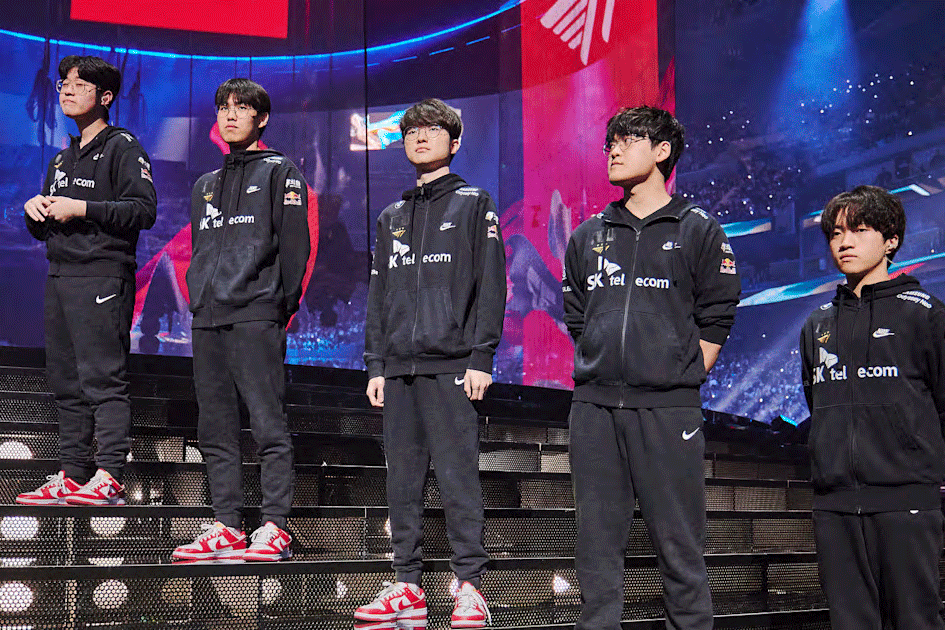
Faker quickly emerged as one of the most mechanically gifted players in the game. His performances helped SK Telecom T1 reach the 2013 League of Legends World Championship, where the Korean team captured its first Worlds title. It was the beginning of a dynasty.
Building the First T1 Dynasty
SK Telecom T1’s early League of Legends success was not limited to a single championship.
After missing Worlds in 2014, the organization rebuilt and returned with one of the strongest lineups in League of Legends history. SKT won the 2015 World Championship and successfully defended the title in 2016.
That run gave the organization three Worlds championships in four appearances between 2013 and 2016.
SKT also became a dominant force domestically in League of Legends Champions Korea and won consecutive Mid-Season Invitational titles in 2016 and 2017.
The combination of Faker, elite teammates and coach Kim «kkOma» Jeong-gyun created a competitive standard that other organizations spent years trying to match.
T1 was no longer simply one of Korea’s strongest teams. It had become the defining organization of the first major era of professional League of Legends.
Faker Becomes the Face of T1
No player has influenced the identity of T1 more than Faker. He joined the organization as a teenager in 2013 and has spent his entire professional career representing the same team. In an industry where roster changes are constant, that continuity has made the relationship between Faker and T1 exceptional.
His career has also followed the evolution of League of Legends esports itself. Faker was already a world champion during the game’s early international expansion. He remained at the top as professional League became more structured, commercially valuable and globally competitive.
His longevity eventually allowed him to compete against multiple generations of professional players.
By the end of 2025, Faker had won six League of Legends World Championships with T1. His career included the organization’s original titles in 2013, 2015 and 2016 before another championship cycle began years later.
Beyond trophies, Faker became one of the most recognizable esports players in the world and a central figure in T1’s international identity.
From SK Telecom T1 to T1
The organization underwent another major transformation in 2019. SK Telecom and Comcast Spectacor formed a global esports joint venture that became T1 Entertainment & Sports. The move expanded the organization’s ambitions beyond its traditional identity as a South Korean esports team.
The SK Telecom T1 name was shortened to T1 as part of that transition. The new structure gave the organization operations across Seoul, Philadelphia and Los Angeles while creating a platform for expansion into additional games, content, merchandise and other parts of gaming culture.
This was an important shift in what T1 represented. The organization still depended heavily on competitive success, particularly in League of Legends, but its long-term objective increasingly resembled that of a global sports and entertainment brand.
The Return to the Top of League of Legends
Remaining successful for more than a decade is rare in esports. T1 managed to build another championship era long after the roster that dominated the mid-2010s had disappeared.
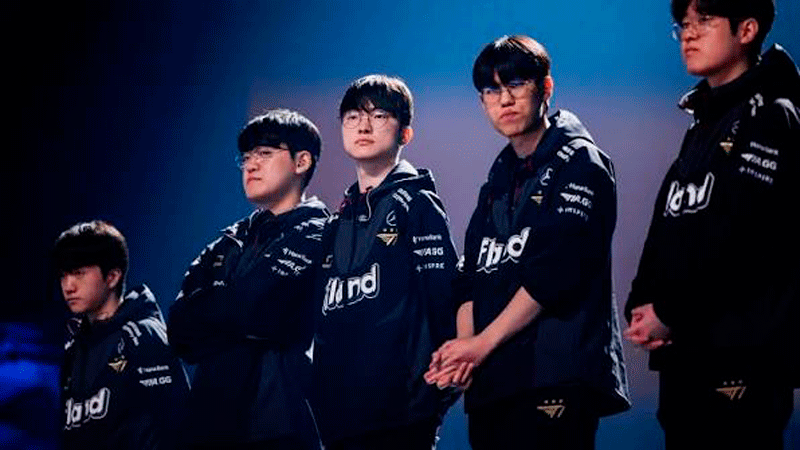
Faker remained the constant, but a new generation developed around him. Players including Choi «Zeus» Woo-je, Mun «Oner» Hyeon-jun, Lee «Gumayusi» Min-hyeong, Ryu «Keria» Min-seok and later other additions helped T1 return to the center of international League of Legends.
The organization won Worlds again in 2023, ending a seven-year wait for another world title.
T1 defended the championship in 2024. Then came another title in 2025, when T1 defeated KT Rolster 3-2 in the World Championship final in Chengdu. The result completed three consecutive Worlds victories and increased the organization’s record to six world championships.
It also demonstrated what makes T1 unusual. The first and sixth titles arrived 12 years apart, yet Faker was part of both championship teams.
Six World Championships and an Unmatched Legacy
T1’s six Worlds titles make the organization the most successful team in the history of the League of Legends World Championship.
The championships came in: 2013, 2015, 2016, 2023, 2024, 2025. The distribution of those titles is almost as important as the total.
T1 did not dominate during only one short competitive window. It built championship rosters across different eras of League of Legends, adapting to major changes in players, strategies, formats and the overall level of international competition.
The three consecutive championships from 2023 through 2025 created a second dynasty around the same organization that had defined Worlds a decade earlier.
Few esports teams have managed comparable longevity at the highest level of a single game.
T1 Beyond League of Legends
League of Legends remains the foundation of the T1 brand, but the organization has operated across a much broader range of esports.
Its history includes teams and players in games such as StarCraft, VALORANT, PUBG, Overwatch, Apex Legends, Super Smash Bros., Fortnite and EA SPORTS FC.
The exact portfolio has changed over time as T1 has entered and exited different competitive ecosystems.
In 2026, the organization’s official competitive operations span League of Legends, VALORANT, Overwatch, PUBG: Battlegrounds, FC Online, Teamfight Tactics and fighting games, alongside additional gaming divisions.
This multi-title strategy gives T1 opportunities to reach audiences outside League of Legends while maintaining its position in South Korea’s esports industry.
However, the organization’s identity continues to be anchored by the game that transformed SK Telecom T1 into an internationally recognized name.
Developing the Next Generation
Another important part of T1’s longevity is its ability to develop players rather than relying exclusively on established stars.
The organization has built a development structure around its League of Legends operation, giving younger players a pathway toward professional competition.
That approach became particularly valuable as T1 moved from its first championship generation to the roster that eventually returned the organization to the top of Worlds.
Developing players internally provides more than potential roster replacements. It allows younger competitors to learn within the same infrastructure, expectations and competitive culture as the main team.
For an organization that expects to contend for championships every season, maintaining that pipeline is essential.
Building T1 as a Global Brand
Competitive results created the T1 brand, but the organization has increasingly looked beyond tournament trophies.
The 2019 joint venture between SK Telecom and Comcast Spectacor was designed in part to accelerate international expansion. T1 subsequently developed its commercial operations around sponsorships, merchandise, content and fan engagement.
Faker’s international profile gives the organization an advantage few esports brands can reproduce. His presence connects T1 with audiences far beyond South Korea and even beyond the regular League of Legends fanbase.
At the same time, T1 has worked to ensure the organization itself remains recognizable independently of individual tournaments.
Its distinctive red branding, championship history and association with Korean esports have helped turn T1 into one of the industry’s most identifiable names.
Why T1 Matters to Esports
T1’s importance cannot be measured solely through championships. Its history connects several generations of esports.
The organization emerged from South Korea’s StarCraft era, entered League of Legends during the game’s rapid growth, built the first major LoL dynasty, transformed into an international esports business and then returned to championship dominance more than a decade after its first Worlds victory.
That continuity is extremely difficult to reproduce in an industry where games, organizations, sponsors and competitive formats can change rapidly.
T1 has survived those changes while maintaining a clear competitive identity. Its six League of Legends world championships are the most visible result, but the organization’s broader achievement is remaining relevant across more than 20 years of esports history.
What Comes Next for T1?
By 2026, T1 is no longer trying to establish its place in esports history. That place is already secure.
The challenge is maintaining it.
The organization continues to compete across multiple titles while its League of Legends team carries expectations created by six Worlds championships and an unprecedented three-title run from 2023 to 2025.
At the center of that story remains Faker, whose career has connected nearly every major chapter of T1’s League of Legends history.
Eventually, however, T1 will have to prove that the institution it built can remain at the top beyond any single player.
Its history suggests the organization is designed with that objective in mind.
From Team Orion and the StarCraft era to SK Telecom T1, Faker and six League of Legends world championships, T1 has repeatedly adapted without losing the competitive identity that made it famous.
More than two decades after its origins, T1 remains not simply one of South Korea’s biggest esports organizations, but one of the defining teams in the history of competitive gaming.