VALORANT features a total of 12 maps, though only seven are available at a time in competitive (ranked and premier) and deathmatch game modes. If you’re interested in finding the list of maps currently active in VALORANT, you’re in the right place.
The map rotation in VALORANT is regularly updated to keep the gameplay experience dynamic for seasoned players while providing new players a chance to acclimate. New maps are introduced every few Acts, and existing maps are cycled in and out of the rotation. When returning maps are reintroduced, they may either undergo adjustments based on player feedback and current gameplay trends or come back unchanged.
As of Season V25, Act Five, here is the current map rotation for VALORANT, along with insights into future updates for the map pool.
What maps are currently in the VALORANT map rotation?
The ranked map pool for VALORANT during Season V25, Act Five, includes the following locations:
- Sunset
- Ascent
- Haven
- Corrode
- Bind
- Abyss
- Lotus
The latest adjustments to the competitive map rotation were implemented with Patch 11.04, coinciding with the start of Act Five in Season V25, reintroducing Abyss while removing Icebox from play.
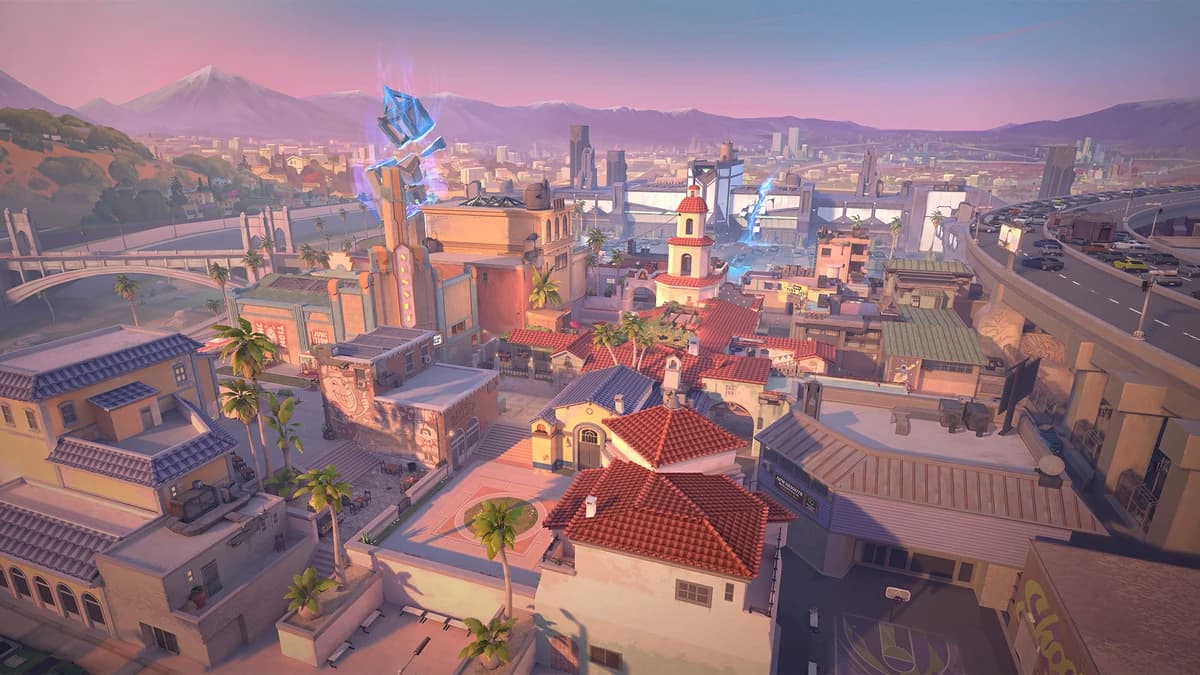
Sunset
Inspired by sunny Los Angeles, Sunset is designed to be straightforward, with no special gimmicks aside from a unique door that connects the mid-section to B, which can be opened, closed, or destroyed. Quick decision-making is critical for success on this map, particularly regarding rotations. Pay close attention to the central area and ensure you have a reliable sentinel to cover flanks and secure your territory.
Ascent
Ascent features switch-operated doors leading into each site. One door connects B Site to Mid Market, while another links A Site to A Tree. Utilizing these doors can provide valuable time and information about retakes, while destructively preempting them can hinder the enemy’s plans. Mid control is essential here, allowing attackers to navigate either to A via Mid Catwalk or toward B using Mid Market.
Haven
Haven is VALORANT’s first map featuring three sites, beloved by the community. It’s a spacious map that favors attackers, making site retakes generally easier than hold-offs.
With multiple ways to enter sites, such as through C Garage, Mid, and A Sewer, spread your team and utilities to gather intel on attackers. Fortunately, Haven has not received any major updates, so returning players will quickly feel at home.
Corrode
Corrode, VALORANT’s latest addition, is a three-lane, two-site «radianite salt mining facility» that encourages both quick and strategic gameplay. Though it lacks unique features like teleporters or destructible doors, it remains challenging.
Both attackers and defenders must navigate many angles and open areas before attempting to seize control of the tightly packed sites. A central area facilitates flanking and sniping, ideal for aggressive players using shotguns. Given the numerous alternatives, expect to rely on retake or flank strategies in various situations. Players should also stay alert for Sova and Cypher operators, as much of the map is wall-bangable.
Bind
Bind’s defining feature is its two teleporters, which allow for swift map rotations. Playing on this map demands patience, as attackers may still rotate to B even if the entire team is focused on A. The absence of a mid-section means teams can function without a sentinel for flank control.
Proximity tactics work well on Bind, with agents like Raze and Harbor excelling here. If you struggle with the Vandal, purchasing a Judge can secure kills each round. Having at least one initiator is crucial for success on this map, enabling players to spray through smokes for free kills, while longer sightlines at B Long and A Tower can be effectively held with an Operator.
Abyss
Abyss boasts a unique and ambitious design, littered with hazards that can lead to falls–definitely not for the acrophobic. Uniquely, it’s the only map without defined boundaries.
If you’re willing to take a chance, the risky edges and tight paths present numerous tactical opportunities. Skilled agents can exploit alternative routes to gain the upper hand, using quirky abilities to send unsuspecting foes off cliffs or to ensure survival. The map’s potential is vast.
Lotus
Lotus stands out as another three-site map, in addition to Haven, offering myriad strategic options that keep players engaged.
With three intricate plant locations, Lotus features significant neutral zones that facilitate thrilling clashes. Unique elements include a rope ascender, a silent drop, and both breakable and rotating doors, enhancing battle dynamics.
Icebox (out of rotation)
Icebox’s compact and intricate layout supports diverse strategies and precise aim. It was noted for having Spike plant spots at varying heights; both sites feature «nests» for planting and defending Spike from a distance. Securing mid control is crucial for victory on this map, though its unpredictability adds to the appeal.
Icebox was the latest map removed in Patch 11.04.
Fracture (out of rotation)
Though never the most popular choice, Fracture facilitates various unique strategies due to its distinct features, remaining unchanged since Patch 7.04. With four central zones hosting the plant sites and spawns, players must be vigilant to avoid flanking threats.
Breeze (out of rotation)
Breeze encourages players to creatively engage with enemies, featuring long corridors and expansive areas suited for aggressive strategies. However, it is sniper-friendly, which might deter some players.
While not currently in the competitive rotation, Riot may reintroduce Breeze in a future Act with possible adjustments.
Split (out of rotation)
Set in Tokyo, Split is a close-quarters map with numerous areas and angles to control, but it lacks long-range sightlines apart from Mid and A Screens, which can be effectively blocked by smokes to facilitate attacks.
Featuring two ziplines–one linking the B site to B Tower and another in Mid Vent–Split allows for unique angles or ambush strategies.
Pearl (out of rotation)
This underwater map is less favored among players and lacks unique mechanics but offers versatile gameplay through extensive mid control. The Mid section connects various map points, allowing players to directly approach sites or utilize flanking strategies through Mid Connector.
Why does VALORANT implement a map rotation?
As a live-service FPS, VALORANT consistently provides fresh content since its launch, with Riot regularly introducing new agents, skins, and maps.
On average, Riot adds a new map approximately every six months. The map rotation concept was first introduced in 2022 during the game’s fifth competitive Episode, once the total number of standard maps reached eight. Maps utilized in Team Deathmatch are excluded from this total.
During the announcement of Pearl’s release in June 2022, VALORANT‘s map design lead, Joe Lansford, stated that a competitive pool of seven maps was adopted after feedback from esports teams, players, and professional organizations.
Lansford highlighted the challenges inherent in learning a new map within a tactical shooter, which influenced the decision to have both active and inactive map pools. Mastery of each map can be demanding, and limiting the map pool to seven fosters both variety and depth. New players have less to grasp as they enter VALORANT, while existing players are not burdened with discovering a new map.
Importantly, this map rotation is exclusively for Competitive, Premier, and Deathmatch modes. Other modes such as Unrated and Spike Rush continue to feature all 11 maps, while Team Deathmatch has its own distinct set.
Beginning in the 2025 season, VALORANT’s competitive map pool will experience updates with each new Act. During this process, Riot will alternate existing maps, with or without tweaks, every Act, while also occasionally adding new maps.