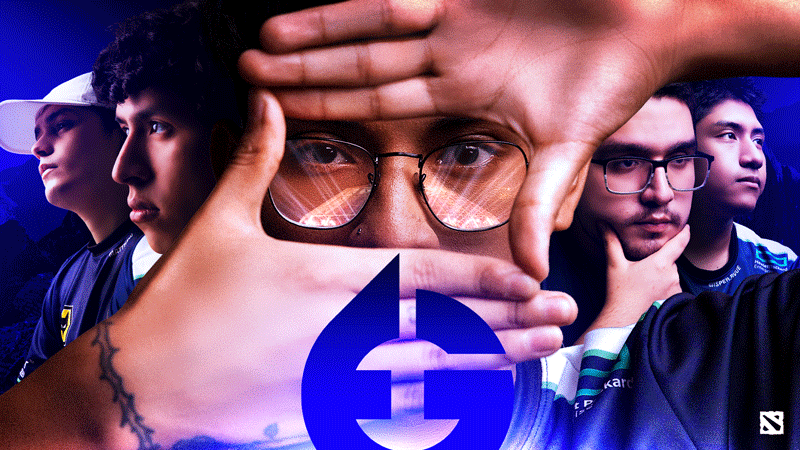
Long before esports became a billion-dollar industry filled with franchised leagues, international arenas and professional training facilities, Evil Geniuses was already competing. Founded in 1999, EG survived multiple generations of competitive gaming and built championship teams across Dota 2, Counter-Strike, Call of Duty, League of Legends and VALORANT. More than 25 years later, its history reflects the evolution of esports itself.
Before esports became an industry
The story of Evil Geniuses begins in 1999, when competitive gaming was still far removed from the professional ecosystem that exists today.
The organization originated as a gaming clan and gradually developed into one of the best-known multigame brands in North American esports. Over the following decades, EG would enter and leave numerous titles as competitive scenes emerged, expanded or disappeared.
That ability to move between generations of games became one of the defining characteristics of the organization.
Quake belonged to EG’s earliest period, but the organization later became associated with games including Counter-Strike, Warcraft III, StarCraft, fighting games, Dota, Call of Duty, League of Legends and eventually VALORANT.
By the beginning of the 2010s, Evil Geniuses was already one of the established names of Western esports.
StarCraft and the rise of the EG identity
StarCraft II became an important part of that identity.
When Blizzard released the game in 2010, Evil Geniuses invested heavily in the competitive scene and assembled a roster featuring several prominent Western players.
One of the most recognizable was Gregory «IdrA» Fields, whose performances and outspoken personality made him one of the best-known non-Korean StarCraft II players of the era.
EG also operated a gaming house in Phoenix, Arizona, providing its players with a structured practice environment inspired by the professional team houses that had become common in South Korea.
The organization’s involvement in StarCraft II helped establish the image that followed EG for years: talented players, major personalities and a willingness to position itself among the biggest organizations in Western esports.
But another game would eventually deliver its most important championship.
Dota 2 and the defining Evil Geniuses era
Evil Geniuses officially entered Dota 2 in 2011, shortly after Valve held the first edition of The International.
The division went through several roster changes during its early years, but Clinton «Fear» Loomis became one of the central figures of EG’s Dota identity.
By 2014 and 2015, the organization had assembled one of the strongest teams in the world.
The lineup that eventually reached The International 2015 featured Fear, Peter «ppd» Dager, Saahil «UNiVeRsE» Arora, Sumail «SumaiL» Hassan and Kurtis «Aui_2000» Ling.
SumaiL was particularly remarkable.
Born in Pakistan and later based in the United States, he was only 16 when EG arrived at The International 2015. Despite his age, he had already become one of the team’s most important players.
The tournament would change both his career and the history of the organization.
The International 2015
The International 2015 was held in Seattle with a prize pool exceeding $18 million, an extraordinary figure for esports at the time.
Evil Geniuses entered the event as one of the leading contenders but had to navigate a difficult playoff bracket.
One of the defining moments came in the lower-bracket final against LGD Gaming. EG won the series and earned a place in the grand final against Chinese qualifier CDEC Gaming.
CDEC had produced one of the tournament’s biggest runs, advancing from the wildcard stage all the way to the final.
EG ended it there.
Evil Geniuses defeated CDEC 3-1 to become The International 2015 champions.
The victory earned the team approximately $6.6 million, the largest first-place prize in esports history at that point.
It also produced one of Dota 2’s most famous competitive moments.
During the fourth game of the final, EG executed a combination involving UNiVeRsE’s Earthshaker and SumaiL’s Storm Spirit near the Roshan pit. The play became known throughout the Dota community as the «six million dollar Echo Slam.»
For Evil Geniuses, TI5 became the championship most closely associated with the organization’s first two decades.
EG remained a major Dota 2 organization for years afterward, regularly appearing at The International and other major events.
The organization never won TI again, but its presence became deeply connected with North American Dota.
That relationship eventually ended in 2023, when EG exited the game after more than a decade of competition.
Success beyond Dota
Dota was never the only game in which Evil Geniuses found success.
The organization maintained a significant presence in fighting games, signing players such as Justin Wong, Ricky Ortiz, Momochi and later Dominique «SonicFox» McLean.
EG competitors appeared across major fighting game tournaments, including EVO, giving the organization another connection to one of competitive gaming’s oldest communities.
Call of Duty produced another world championship.
At the 2018 Call of Duty World League Championship, Evil Geniuses entered with Patrick «ACHES» Price, Bryan «Apathy» Zhelyazkov, Justin «SiLLY» Fargo and Adam «Assault» Garcia.
The team defeated Team Kaliber in the final and became Call of Duty world champions.
Assault was named tournament MVP.
Three years after winning The International, EG had captured another world-level title in an entirely different esport.
The return to Counter-Strike
Counter-Strike was also part of Evil Geniuses’ history long before the organization’s modern era.
EG competed in earlier versions of Counter-Strike before leaving the game in 2012. Seven years later, it returned with considerably higher expectations.
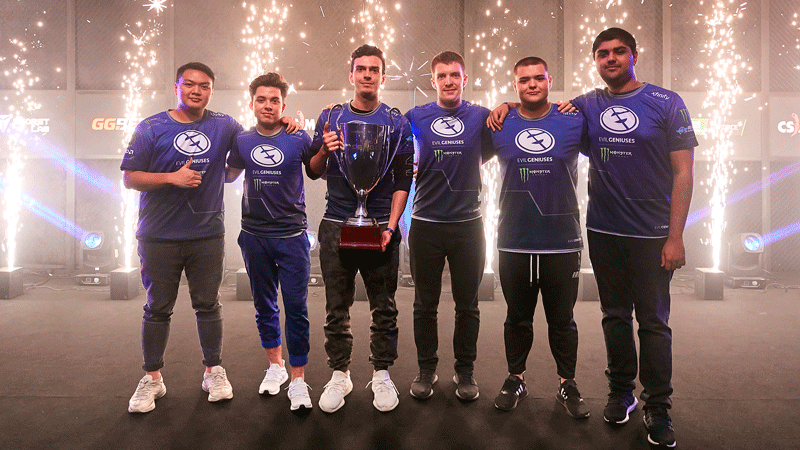
In September 2019, Evil Geniuses acquired the NRG roster of Peter «stanislaw» Jarguz, Vincent «Brehze» Cayonte, Ethan «Ethan» Arnold, Tsvetelin «CeRq» Dimitrov and Tarik «tarik» Celik.
The move immediately produced results.
EG won ESL One New York 2019 shortly after entering CS and later added the StarSeries & i-League Season 8 title.
The team briefly reached No. 1 in the HLTV world ranking.
For a period, Evil Geniuses and Team Liquid gave North America two teams capable of competing near the top of international Counter-Strike.
That peak did not last.
Results declined during the following years, and EG repeatedly rebuilt its roster. The organization attempted an unusually large Counter-Strike project involving multiple lineups and a broader development system, but the approach failed to restore the results of 2019.
By 2023, EG had fallen far from the top of the international scene.
In January 2024, Evil Geniuses officially withdrew from Counter-Strike for the second time.
The contrast was significant: a division that had returned by winning ESL One New York and reaching No. 1 in the world ended less than five years later without a place among the leading North American teams.
A brief but successful League of Legends chapter
Evil Geniuses also returned to League of Legends ahead of the 2020 LCS season.
Its biggest breakthrough came two years later.
The 2022 roster built around Impact, Inspired, jojopyun, Danny and Vulcan developed into one of the strongest teams in North America.
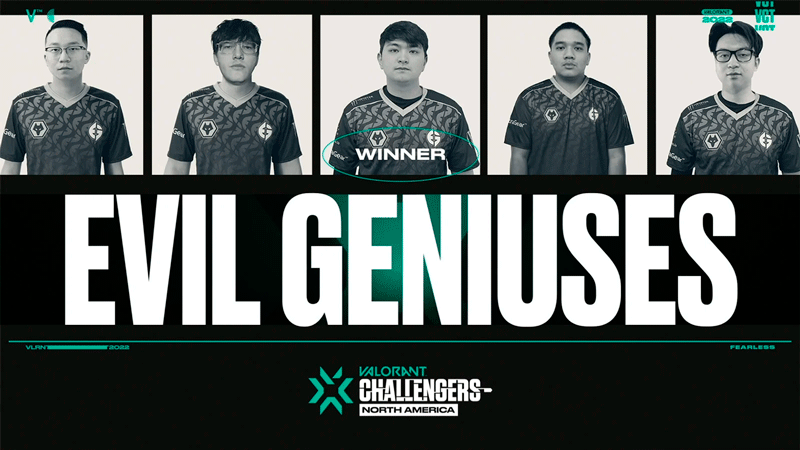
EG reached the LCS Spring playoffs and defeated 100 Thieves 3-0 in the final to win the organization’s first LCS championship.
The victory also sent Evil Geniuses to the 2022 Mid-Season Invitational, where the team reached the semifinals before losing to eventual champion Royal Never Give Up.
EG later qualified for the 2022 League of Legends World Championship.
The project, however, would not develop into a long-term LCS dynasty.
After further roster changes and a turbulent period for both EG and the North American League of Legends ecosystem, the organization left the LCS following the 2023 season.
PEAK6 takes control
Away from competition, Evil Geniuses was also changing as a company.
In May 2019, Chicago-based investment firm PEAK6 acquired the organization.
The acquisition came during a period when esports organizations were attracting increasing levels of outside investment and attempting to transform themselves from competitive teams into larger entertainment and technology businesses.
Under PEAK6 ownership, EG expanded its operations and entered several major esports ecosystems.
The organization competed simultaneously across titles such as Dota 2, Counter-Strike, League of Legends, VALORANT and others.
But the following years would also produce major restructuring.
By the end of 2023 and beginning of 2024, Evil Geniuses had exited League of Legends, Dota 2 and Counter-Strike.
One major championship division remained.
VALORANT and an unlikely road to a world title
Evil Geniuses entered Riot Games’ VALORANT ecosystem early in the game’s competitive history, but its defining run came after EG was selected for the partnered VCT Americas league.
Few expected the organization to become world champion in 2023.
The season began badly.
EG opened the VCT Americas regular season with a 1-4 record and looked unlikely even to reach the playoffs.
The team recovered, however, winning three of its next four matches and qualifying for the postseason.
A major part of that turnaround was the emergence of Max «Demon1» Mazanov.
Demon1 had begun the season outside the starting lineup but developed into one of the most dangerous players in the league. Alongside Kelden «Boostio» Pupello, Ethan Arnold, Alexander «jawgemo» Mor and Corbin «C0M» Lee, he helped transform EG from an afterthought into an international contender.
Evil Geniuses finished third in the Americas playoffs and qualified for Masters Tokyo.
Then the run became global.
From underdogs to world champions
At Masters Tokyo, EG reached the grand final before losing 3-0 to Fnatic.
Even in defeat, the result changed expectations surrounding the team.
A few months earlier, Evil Geniuses had struggled to stay alive in its own regional league. Now it was one series away from an international trophy.
VALORANT Champions 2023 in Los Angeles offered another opportunity.
This time, EG completed the run.
The team advanced through the group stage without losing a map before continuing through the playoff bracket. After losing to Paper Rex in the upper final, EG defeated LOUD in the lower final to earn a rematch against the Pacific champions.
The Champions grand final went four maps.
EG won Split 13-10. Paper Rex responded on Ascent, 13-11. Evil Geniuses then dominated Bind 13-5 before finishing the series with a 13-10 victory on Lotus.
Evil Geniuses defeated Paper Rex 3-1 and became VALORANT world champions.
Demon1 finished the grand final with 101 kills, setting a record at the time for the most kills in a best-of-five at an international VALORANT event.
For EG, the victory carried additional historical significance.
Eight years after winning The International and five years after taking the Call of Duty world championship, Evil Geniuses had reached the top of another major esport.
The games and players had changed completely.
The name on the trophy had not.
The championship roster breaks apart
The VALORANT title did not lead to the dynasty some expected.
During the offseason following Champions 2023, uncertainty surrounded the future of the roster. Eventually, several members of the championship team departed.
Boostio joined 100 Thieves. Demon1 and Ethan moved to NRG. C0M signed with Leviatán.
Only jawgemo remained from the five players who had started the Champions final, while head coach Christine «potter» Chi stayed to lead the rebuilding process.
The breakup became one of the sharpest examples of how quickly success can disappear in modern esports.
EG had climbed from a 1-4 regional record to a world championship in the space of a single season, yet entered the next year with an almost entirely different lineup.
From multigame empire to a narrower Evil Geniuses
The same period represented a broader turning point for the organization.
Evil Geniuses had spent years operating as a large multigame esports brand. By early 2024, many of the divisions most strongly associated with its history were gone.
Dota 2 had ended.
League of Legends had ended.
Counter-Strike had ended.
Rather than maintaining teams across a large number of major esports, EG increasingly centered its competitive identity around VALORANT.
The organization also looked back toward its own history. For its 25th anniversary in 2024, Evil Geniuses restored a version of its classic logo, reconnecting the modern organization with the branding used during earlier periods of its existence.
It was an appropriate symbol for a team whose greatest asset had become longevity itself.
Evil Geniuses in 2026
More than a quarter of a century after its creation, Evil Geniuses remains part of the professional esports landscape.
In 2026, its primary competitive focus remains VALORANT, where EG continues to compete in VCT Americas.
The roster has changed repeatedly since the 2023 world championship, but potter remains the head coach overseeing another generation of the team.
As of August 2026, Evil Geniuses has reached the VCT Americas Stage 2 playoffs after progressing through the Play-Ins, keeping its season alive in the final regional stage of the year.
It is a much narrower competitive operation than the Evil Geniuses that once fielded high-profile teams across Dota 2, Counter-Strike and League of Legends at the same time.
But that transformation is also consistent with the organization’s history.
More than 25 years of surviving esports
Few esports organizations have existed long enough to experience as many different versions of competitive gaming as Evil Geniuses.
EG began before Twitch, before Steam, before League of Legends, before Dota 2 and before the modern concept of franchised esports leagues.
It survived the era of local LAN tournaments, the rise of StarCraft II, the explosion of Dota 2 prize pools, North America’s strongest period in Counter-Strike, the growth of publisher-controlled leagues and the arrival of VALORANT.
Its trophy cabinet reflects that range.
- The International 2015.
- Call of Duty World League Championship 2018.
- ESL One New York 2019.
- LCS Spring 2022.
- VALORANT Champions 2023.
Not every chapter ended successfully. Some divisions collapsed after expensive rebuilds. Championship rosters separated. Games that once defined the organization disappeared from its portfolio entirely.
That is also why Evil Geniuses occupies an unusual place in esports history.
The organization has never been defined by a single game.
Players, rosters and competitive scenes changed around it for more than two decades, while EG repeatedly moved from one generation of esports to another.
From an early gaming clan in 1999 to a Dota 2 world champion in 2015 and a VALORANT world champion in 2023, Evil Geniuses has become one of the few esports brands whose history spans almost the entire development of modern professional gaming.