Plinko stands out in the realm of contemporary casino games, drawing inspiration from a television game show but suitable for online engagement. Its mechanics are quite straightforward: a ball descends through a peg-filled board, ultimately landing in a slot at the bottom, with each slot assigned multipliers that determine your payout.
However, beneath this seemingly simple gameplay is a mathematical framework that influences the frequency with which the ball lands in each slot. Grasping these probabilities can significantly affect your strategy, both in terms of expectations and bankroll management.
This article will delve into the probability mechanics and risk factors inherent in Plinko, providing guidance to enhance your gameplay.
Understanding How Plinko Works
The Plinko game begins when you drop a ball from the top of the board. As it descends, it hits pegs that direct its path either left or right. After a series of these deflections, it finally lands in one of the slots at the bottom. Each slot is associated with a multiplier that defines your payout based on the initial wager you made.
At first glance, it may appear that the ball could land anywhere with equal chances. In reality, however, the mathematics favor the central slots. Since each peg bounce resembles a coin flip, most trajectories end up closer to the center. As you move further from the middle, the likelihood of landing in those edge slots diminishes. This imbalance clarifies why high multipliers are seldom achieved, while lower multipliers predominate in most outcomes.
Casinos frequently provide various configurations of Plinko boards. Differences in the number of rows can alter the probability distribution, and risk levels can change how multipliers are allocated. Understanding these aspects lays the groundwork for deeper analysis that will follow.
Probabilities and Binomial Distribution in Plinko
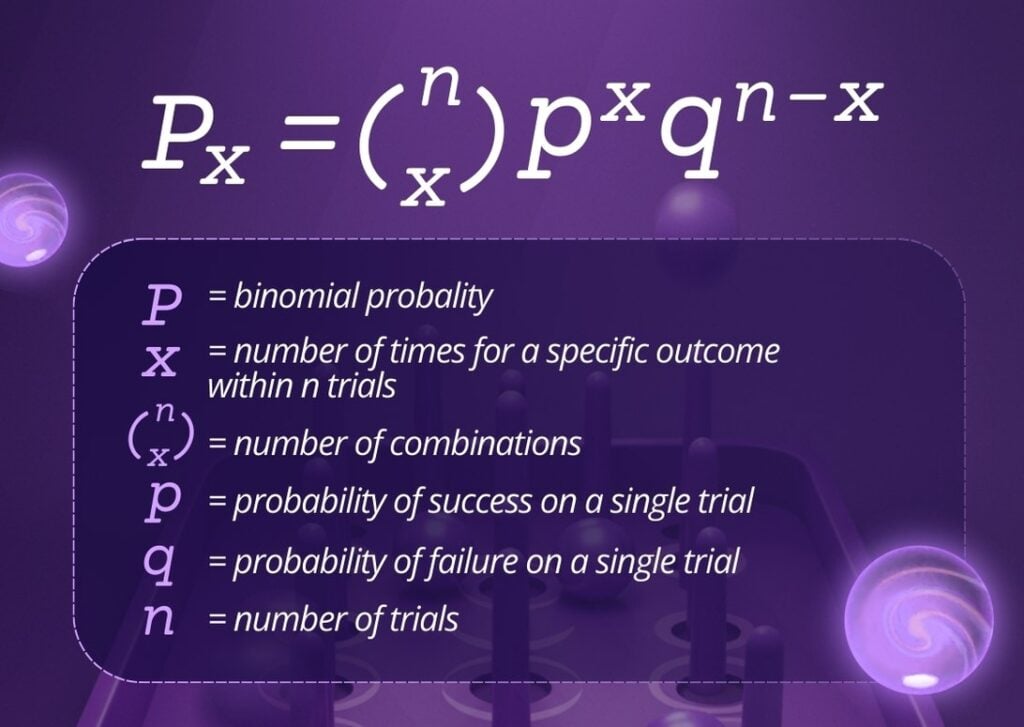
The mathematical foundation of Plinko is based on a well-known statistical model called the binomial distribution. Each time the ball interacts with a peg, it has two possible outcomes: left or right. Given N rows, the ball makes N binary decisions, resulting in a total of 2^N potential paths. The number of times it moves right will ultimately determine which slot it occupies at the bottom.
The binomial formula provides insights into the probability of landing in each slot:
Illustration
On a board with 12 rows:
- Center slot (6 lefts, 6 rights) ≈ 22% probability.
- Adjacent slots (5 rights or 7 rights) ≈ 16% each.
- Edge slots (0 or 12 rights) ≈ 0.02% each.
This model of binomial distribution elucidates the structure of multipliers: central slots yield lower payouts, while extreme slots offer substantial rewards.
Reasons for the Dominance of Center Slots
The prevalence of hits in center slots is a function of variance. Given that each bounce functions as a 50–50 chance, the ball tends to gravitate back towards the middle. The result is a bell-shaped distribution where the majority of outcomes cluster around central positions.
This principle explains why results concentrate around the midpoint of the board. The center slot corresponds to a balanced number of left and right moves, providing the greatest number of possible paths. Conversely, the edge slots can only be reached via unlikely sequences – all lefts or all rights.
Extreme multipliers located at the edges require improbable sequences. For example, to land the far-left slot on a 12-row board, the ball would need to take 12 consecutive left turns, which has odds of 1 in 4,096. The far-right slot carries the same probability. This rarity accounts for the high payouts associated with edge slots, as the game compensates for their improbability with substantial multipliers.
For players, this indicates that hit frequency in Plinko is unequally dispersed across the board. Most returns will come from middle slots, with sporadic hits on the edges to add variety. Understanding this aspect helps set realistic expectations: while pursuing edge multipliers may be thrilling, statistically, your drops are more likely to land nearer the center.
Plinko Configurations: 8 vs 12 vs 16 Rows
The count of rows in Plinko significantly influences the probability distribution. With fewer rows, the spread is tighter, causing the ball to cluster more around the center. With increasing rows, the probability distribution broadens, and although the center continues to dominate, the chances of hitting extreme slots diminish.
Consider three different setups:
- 8 Rows: With only 8 decisions, the chance of hitting edge slots is greater compared to boards with more rows. While multipliers may be lower, extreme outcomes occur more frequently.
- 12 Rows: The balance shifts, with central slots dominating and edge outcomes becoming rare, allowing for higher multipliers on those slots.
- 16 Rows: The likelihood of hitting the extreme left or right consists of very slim odds, enabling casinos to allocate significant multipliers, knowing they will only hit infrequently.
This difference in variance suggests that the number of rows in Plinko directly affects the level of risk involved. Shorter boards promote smoother play with less dramatic fluctuations, while longer boards introduce greater variance with rare but massive payouts. Players should select based on their comfort with risk and volatility.
Plinko Risk Levels, Multipliers, and RTP
Each slot in Plinko has an associated multiplier, and these slot probabilities combined with the multipliers shape the overall potential of the game. Casinos typically allow players to choose between low, medium, and high-risk boards, altering how rewards are distributed.
- Low Risk: Center slots yield payouts close to 1x or slightly higher, while the edges provide modest enhancements. Losses are minimal, but substantial wins are rarely available.
- Medium Risk: Center slot payouts decrease, while edge slots pay more. Volatility is heightened, balancing moderate wins against sharper fluctuations.
- High Risk: The center slots often pay less than 1x, resulting in frequent small losses, but edge multipliers can soar, potentially reaching 100x or more.
Throughout these setups, the house edge remains relatively consistent, generally ranging from 1% to 3%, depending on the operator. This means that while the long-term RTP stays stable, the risk profile varies significantly.
Comprehending Plinko’s risk levels is essential: a low-risk board can extend your bankroll, whereas high-risk scenarios create short but intense sessions.
Session Risk: Possibility of Losing Your Bankroll
For Plinko players, a primary concern is the possibility of depleting their bankroll. The risk of going bust is influenced not only by RTP but also by variance, bet size, and session duration.
For example, wagering 100 units at low risk may allow for hundreds of drops, as most hits near breakeven. At medium risk, the probability of going below zero increases, but occasional moderate wins might counterbalance the losses. In high-risk scenarios, bankrolls can deplete rapidly if edge multipliers are not achieved within a reasonable number of drops.
This emphasizes the impact of the Plinko house edge: mathematics ensures the casino’s advantage, yet session results can vary widely based on risk levels and row counts. Players who bet larger amounts relative to their bankroll expose themselves to greater bust risks, while more conservative betting can mitigate this risk. Understanding these probabilities aids in setting achievable session goals and avoiding overextending oneself.
Expected Value and Bankroll Considerations
Each round of Plinko has a long-term mathematical return known as expected value (EV).
This value correlates directly with RTP, which generally falls between 97% and 99% depending on the provider. Regardless of the risk level or the number of rows selected, the expected value of Plinko reflects the game’s inherent house edge.
How Variance Affects Gameplay
Even though the EV remains consistent across different online casino games, variance varies significantly between low, medium, and high-risk boards. On low-risk configurations, outcomes tend to cluster near breakeven, resulting in relatively modest fluctuations during sessions.
Medium-risk boards widen the distribution, resulting in streaks of smaller losses interrupted by occasional wins. High-risk setups magnify this effect, causing frequent losses alongside the rare potential for substantial wins.
Bankroll Considerations
Due to the pronounced differences in volatility, careful bankroll planning is vital. Smaller bets relative to total funds can help cushion against downturns in medium or high-risk scenarios. While larger bets may be feasible on low-risk boards, they can quickly deplete your bankroll in high-risk situations.
Understanding how EV interacts with variance can guide you in selecting bet sizes that match your risk tolerance and desired session length.
Sample Outcomes Overview
Visual representations simplify the comprehension of Plinko’s probabilities. A graphical breakdown reveals how multipliers correspond to slot frequencies, clarifying the balance between frequent small payouts and rare, significant wins.
For instance, on a 12-row medium-risk board, the central slots may yield payouts of 0.5x to 1x and account for the majority of results. Outer slots might offer higher payouts, such as 9x or 26x, but hit less frequently. The extreme edges could provide multipliers of 130x or beyond, yet with hit probabilities in the very low percentage range.
A Plinko outcomes chart makes evident the relationship between multipliers and their probabilities. For bankroll management, it becomes clear that the far edges are statistically anomalies, while the central positions yield more consistent but smaller returns.
Translating Pegs into Probabilities
Though Plinko may appear straightforward, its foundation is built on precise mathematics. Each bounce follows predictable probabilities, resulting in a distribution where central hits are frequent, and extreme outcomes are rare. By grasping how rows, risk levels, and multipliers interact, players can approach the game with informed expectations.
What changes is not the house advantage itself, but rather your management of the session. Opting for smaller bets can prolong gameplay, while higher stakes lead to rapid swings. Although the calculations cannot guarantee outcomes, they provide a helpful structure for strategizing your bankroll and recognizing the limits of what the distribution permits.
Often seen as a form of entertainment, Plinko is fundamentally governed by numerical principles. Engaging with these numbers more thoughtfully transforms each drop into a calculated decision rather than a mere gamble.