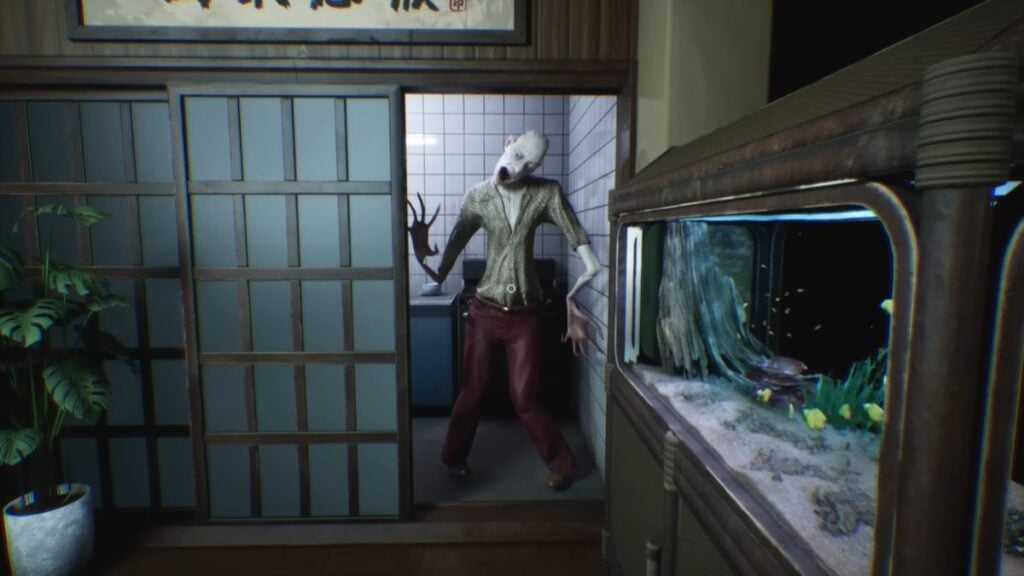
In the game Who’s at the Door, the unnamed main character finds themselves confined to their apartment, under strict instructions from their doctor to take medication for eight days to complete a treatment regimen. However, the challenge lies in the uncertainty of whether the person delivering the medicine is real or merely a figment of their imagination. How can one begin the path to recovery under such conditions?
Fortunately, players will understand the key elements to observe. This anomaly-hunting game revolves around two distinct types of hallucinations: those that are persistent and others that actively pursue you.
Drawing inspiration from titles such as I’m on Observation Duty, The Exit 8, and BrokenLore: DON’T WATCH, Who’s at the Door skillfully intertwines psychological horror with supernatural elements, leading you through a maze of visions that blur the boundaries between reality and imagination. The essential question remains: what is actually true, and whom can you rely on when your mind itself is deceiving you?
Overview of the Story in Who’s at the Door
The first two days serve as a tutorial, guiding players through the initial steps. On day one, the character goes to the door to receive medication from a peculiar female visitor with exaggerated facial features, raising questions about whether she is simply a hallucination or a skewed reflection of reality. The core gameplay officially begins on day three, where the player must identify potential anomalies before answering the door. Distractions from anomaly hunting are common, yet keeping an eye out for doll parts is essential for progressing through the game’s cycles.
Failing to take medication or incorrectly interacting with anomalies can reset progress. Players will encounter three types of visitors at the door, each represented in quirky sketches etched onto the starting table as a reminder for the protagonist.
Scattered throughout the apartment are fragments of lore, though the character struggles to piece it all together. These fragments offer hints of a past–your past. Collecting doll parts, including the head, torso, and legs, reveals pieces of history, ultimately completing a loop of a character’s story.
Unraveling the Past
A card belonging to the director of the Sunshine Clinic contains a name the protagonist somewhat recognizes, but fails to remember the significance. As they take their medication, their memories shatter further. Connections emerge between the protagonist and the Korean Hospital Director, depicted alongside memories of Bori and Ms. Gomu. However, a pivotal photograph remains turned away from view.
In a chilling scene reminiscent of P.T., a news broadcast anomaly reports on a triple homicide in Gyeonggi Province, with medical equipment discovered at the crime scene, deepening the protagonist’s ties to past events. Is it possible that the three visitors at the door are the victims of this tragedy?
Attempts to flee the apartment fail once day nine arrives. An unseen force strikes from behind, prompting a restart with an even darker atmosphere.
Bori’s Tale
The narrative unfolds as follows: A man becomes entranced by a woman named Bori after observing her perform at a bar. Obsessed, he begins to stalk her. After initially feeling frightened, Bori mistakenly opens up to him, unaware of his true nature. He invites her to stay for the night, and once she accepts, he conducts grotesque experiments to uncover what lies beneath her beautiful exterior, leaving her face disfigured.
Takgu’s Story
Takgu, the man who was following Bori, mistakenly believes she is his lost daughter. The physician facilitates a hair transplant for Takgu, who has succumbed to alcoholism due to guilt over his daughter’s disappearance. The peculiar procedure involves sewing hair into the roof of his mouth–does this reflect a warped attempt at reuniting father and daughter?
Ms. Gomu
The final storyline revolves around Ms. Gomu, a former orphanage teacher who joined a cult seeking financial help. Faced with her husband’s bankruptcy and her son’s inability to afford education, she desperately turns to the cult, only to be deceived by the physician into undergoing a ritualistic surgery under the guise of aiding Bori.
Who are the Visitors?
The large-featured woman is identified as Bori, the smiling woman represents Ms. Gomu, and the man with hair emerging from his mouth is Takgu. Upon successfully completing each eight-day cycle and assembling a doll on the ninth day, players reveal the stories of one victim at a time. The question remains: why are the protagonist’s actions being haunted by these figures?
Conclusion of Who’s at the Door
While players might perceive various endings, Who’s at the Door ultimately leads to one clear conclusion. Attempts to escape culminate in a repetitive cycle of eight days that continues until the treatment cycle is complete, tricking the protagonist into thinking progress is being made. Rather than mere loops, these segments advance the narrative as players search for new doll parts, piecing together the lore of the subsequent victim.
The tales of all three victims reveal a disturbing truth about an antagonist who isn’t just a serial killer but a deranged physician who exploited his position, destroying many lives. An oversight on his part, however, is that these victims share a bond and seek retribution.
In a shocking turn, it’s discovered that the protagonist, Mr. Kim, is the actual villain. The player has been embodying the physician throughout the game. Instead of facing the guilt of their actions, the victims become tangible consequences of his transgressions. They deliver him a fitting «taste of his own medicine,» subjecting him to the same procedures inflicted upon Bori, Ms. Gomu, and Takgu. Trapped in a state of perpetual confusion between reality and delusion, he is condemned to spend eternity in solitary torment. The concluding news alert confirms that the suspect has gone missing, a grim yet deserved end for his heinous deeds.
Mr. Kim is doomed to live through the same final eight days of treatment on a continuous loop, likely until his demise, serving as his just punishment.